
11 November 2026
Planning the Court Lines on a Multi-Sport Hall Floor
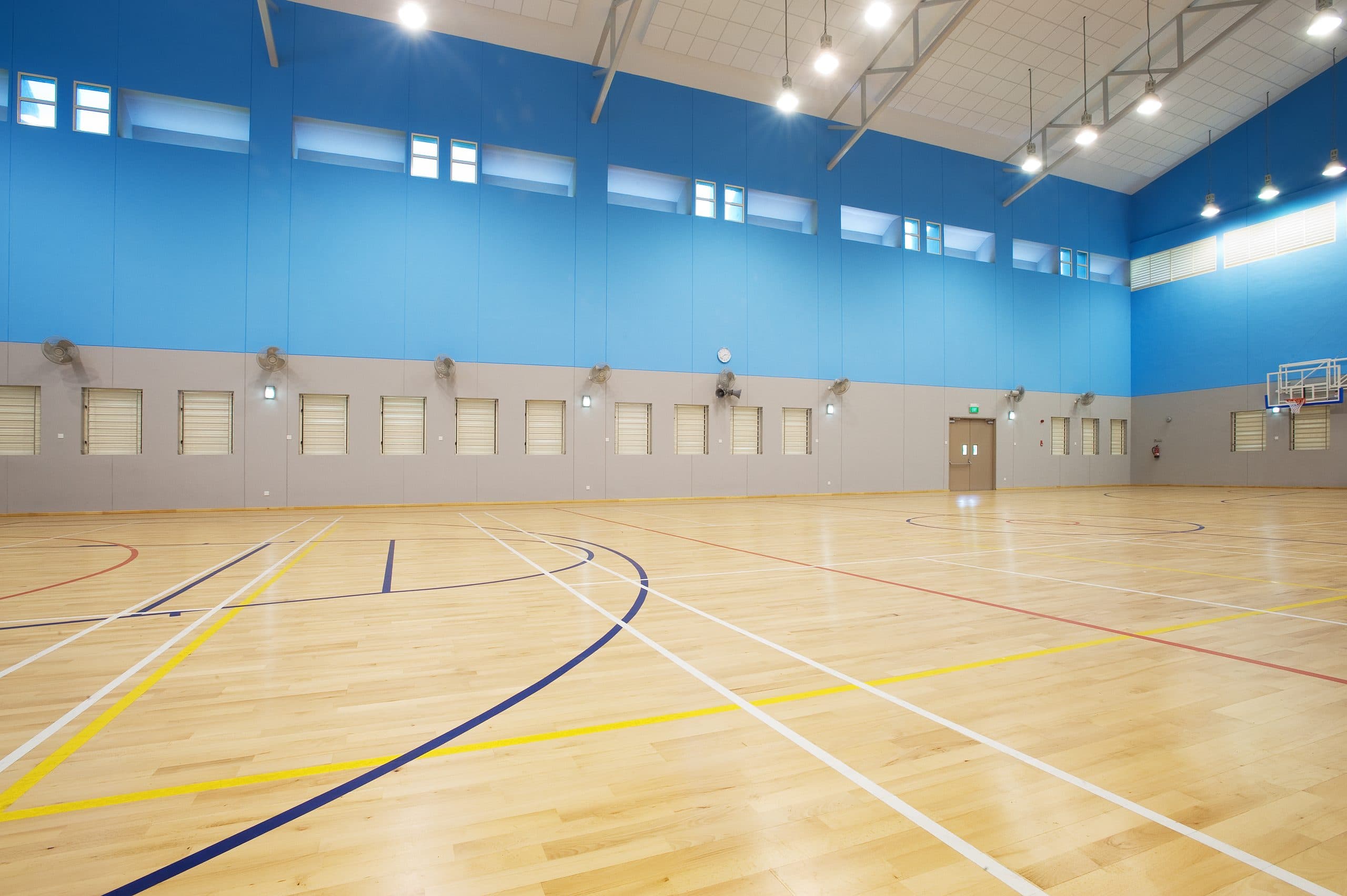
Table of Contents
- Decide Who the Hall Is For
- Widths and Colours Each Sport Expects
- How Painted Lines Go On a Timber Floor
- Tape, Events and Changing the Lines Later
- Frequently Asked Questions
A multi-sport hall carries several sets of courts on one floor. When the plan works, players read their own lines without thinking. When it doesn't, a badminton doubles line runs through a basketball key in the same colour and nobody is sure which line they just stepped on.
On Junckers timber sports flooring, court lines are painted onto the lacquered surface and then sealed under a coat of lacquer that covers the whole floor, so the line plan is best settled before marking starts. Lines can be added afterwards by repeating the routine. Taking one away is a different matter, covered further down.
This guide covers which sports, which colours, and how the lines are applied. The floor systems themselves are on our wooden sports flooring page.
Key Takeaways
- Rank the sports first, and give the main sport the strongest contrast against the timber.
- FIBA's Venue Guide calls for 50mm basketball lines. The BWF Laws set badminton lines at 40mm.
- In Junckers' method, the line paint goes on under a full-floor coat of HP800 Sport, which protects the lines and keeps the friction uniform.
Decide Who the Hall Is For
Start with a list of every sport the hall will host, then put it in order.
Treat colour as a budget. Every extra set of lines is one more thing for a player to filter out, so the strongest contrast against the timber is best spent on the sport played most, or the one that will host competition.
A school hall might rank badminton first, because that is what runs every afternoon, with basketball second. A community centre might reverse them. Neither is wrong. The one thing to avoid is leaving the choice to the marking crew on the day.
Some questions worth answering early:
- How many badminton courts will the hall carry, and do they sit inside the basketball court or across it?
- Will the hall host graded competition in any sport? If so, that federation's rules decide its lines, to the letter.
- Do exams or events need temporary marks on the floor? Keep those out of the painted plan.
Widths and Colours Each Sport Expects
Basketball
FIBA's Venue Guide says the court shall be marked with 50mm lines in accordance with the FIBA Official Rules of Basketball. It also says the boundary area of at least 2.0m around the court shall be marked in a colour contrasting with the inner playing area (FIBA Venue Guide, accessed November 2026).
Badminton
The BWF Laws of Badminton say the court shall be marked out with lines 40mm wide, and that the lines shall be easily distinguishable and preferably coloured white or yellow (BWF Laws of Badminton, 2025, Laws 1.1 and 1.2). Law 1.3 adds that all the lines form part of the area they define. A shuttle on the line is in, so badminton lines should stay unbroken on any court used for matches.
Making them live together
The two widths differ by only 10mm, so colour has to do most of the work.
Junckers' line paint, HP Sport Linemarking, comes in white, yellow, red, blue, green and black, plus a transparent white called Nordic, and Junckers offers customised colours on request (Junckers data sheet F 8.1, HP Sport Linemarking, accessed November 2026). Junckers also recommends using colours of the same batch number to avoid colour differences, worth remembering if a hall is marked in stages.
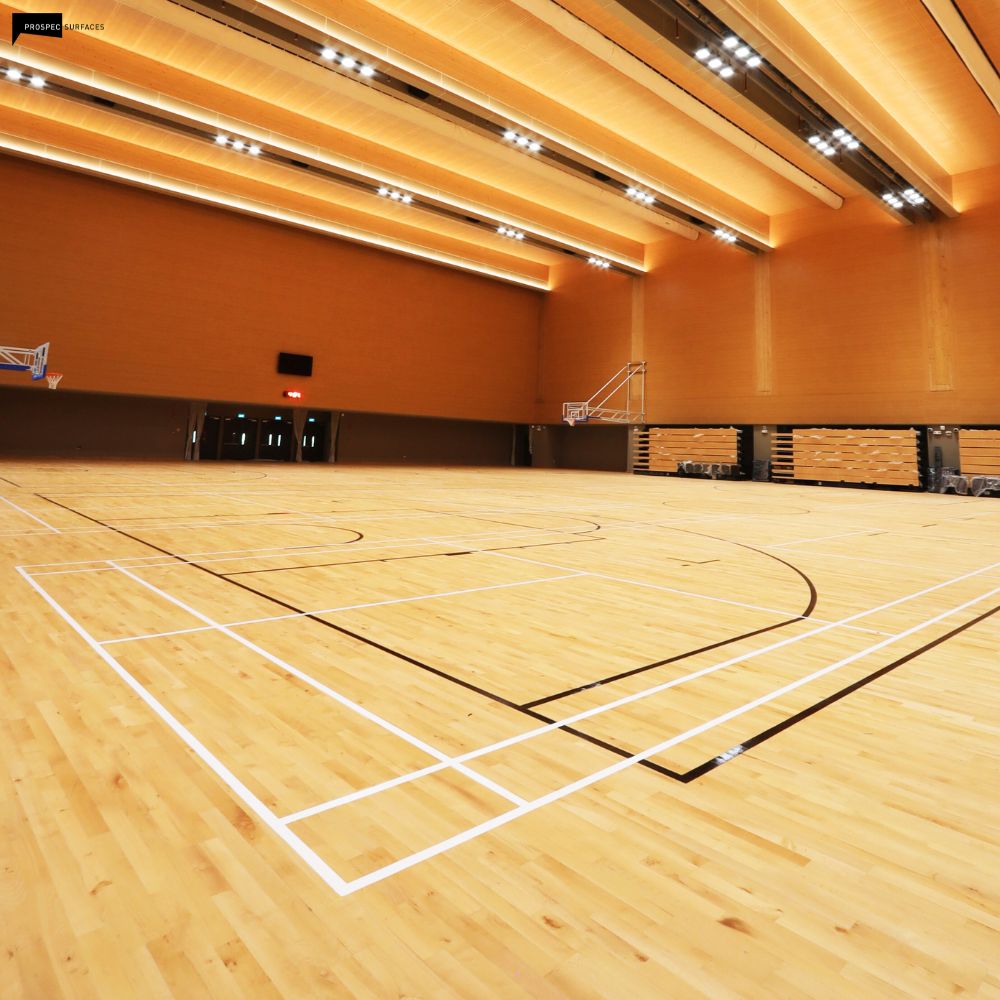
Where lines cross in a hall used for everyday play, we'd suggest letting the main sport's line run unbroken and stopping the secondary line either side of it. For a court that will host competition, check the sport's own rules before breaking any of its lines.
How Painted Lines Go On a Timber Floor
Junckers recommends painted line markings for sports use (Junckers maintenance data sheet G 8.0, accessed November 2026). Junckers sports systems such as the Clip System and UnoBat 45 arrive prefinished, so the lines go onto the factory finish. For new prefinished boards and previously sealed floors, the method in F 8.1 starts by checking that the paint will hold.
- Test. Trial applications go on a couple of spots, two coats 4 hours apart. After 24 hours' drying, each spot is scraped with the edge of a coin to check adhesion.
- Prepare. The floor is washed with Junckers Neutralizer, sanded thoroughly with 150 to 180 grit and vacuumed.
- Mask. Every line is masked with tape of low pull-off strength, pressed down firmly so that it seals tightly and the paint does not bleed.
- Paint. One coat of HP Sport Linemarking goes into the masked areas, by brush or short-haired lacquer roller, and the tape comes off immediately. Junckers puts the drying time at 3 to 4 hours at 20°C and 50% relative humidity.
- Seal. One coat of Junckers HP800 Sport then goes over the full floor area. Junckers says this protects the court line paint and ensures a uniform friction.
An untreated or sanded floor takes more steps: one coat of Junckers WB Primer or SB Primer, a sand along the grain at 150 to 180 grit, then a coat of HP800 Sport left to dry for 24 hours and sanded again at 150 to 180 grit before the lines are masked (F 8.1).
Then there is the wait. F 8.1 lists the line paint as fully cured after 72 hours. G 8.0 recommends giving newly applied lacquer its full curing time before the floor sees high levels of traffic. Both belong in the handover programme. A tournament on the Monday after a Friday marking is one to check first.
Tape, Events and Changing the Lines Later
When tape makes sense
Temporary marks for an event, or desk positions for an exam, are where tape comes in. Junckers warns that the adhesive on tape and logos often has a very high tack value and can damage the lacquer if the tape or logo is pulled off quickly. If temporary taped markings are needed, it says to use only low-tack tapes and logos, such as a removable film with a tack value of no more than 7N/25mm, and to pull them off slowly, with a removal angle of less than 90 degrees for the best result (G 8.0).
We wouldn't let tape stand in for a court that is played on every week.
Changing the lines later
Adding a court after the hall opens means going through the F 8.1 routine again: trial spots, washing, sanding, masking, paint and the full-floor coat of HP800 Sport. Plan for the hall to be closed while that happens.
That routine puts lines on. It has no step for taking an old one off, and neither F 8.1 nor G 8.0 sets out a method for removing a court. What they do establish is where the old lines are: under a coat of HP800 Sport that covers the full floor.
The nearest cases they describe both involve sanding. Where lacquer has worn off in local areas, G 8.0 has those areas sanded down and spot-repaired with HP800 Sport, then the full floor sealed with one coat. Where trial spots fail, F 8.1 says the floor has to be sanded to bare wood and relacquered before court marking can be conducted. So if a court has to come off, we'd have the method confirmed for that floor before any work is booked.
It is also why the line plan belongs at the start of a project. Junckers solid sports flooring can be re-sanded and refinished, and F 8.1 has its own route for a sanded floor, from the primer up. If the courts need redrawing, that refinish is the time to do it.
If you are planning a new hall or refinishing an old one, talk to our team about the floor system early, while the line plan can still change. Our guide to maintaining hardwood sports floors covers routine care.
Frequently Asked Questions
How wide should court lines be?
FIBA's Venue Guide calls for 50mm lines on a basketball court. The BWF Laws of Badminton set 40mm lines for badminton. For any other sport that will host competition, check its federation's current rules.
What colour should badminton lines be?
The BWF Laws say badminton lines shall be easily distinguishable and preferably coloured white or yellow. In a hall shared with basketball, choose between the two by looking at which sport takes priority and what colour the basketball lines are.
Are court lines painted before or after the floor is sealed?
Both. On a prefinished Junckers floor the lines go onto the factory finish once trial spots have passed the adhesion test and the floor has been washed and sanded. A coat of HP800 Sport then goes over the full floor area.
Can lines be changed after the hall opens?
Lines can be added by repeating the Junckers routine, from trial spots to the full-floor coat of HP800 Sport. Removing a court is a separate job. The Junckers data sheets cited here set out no method for it, so we'd have one confirmed before booking any work.
Is tape a good alternative to painted lines?
For temporary markings it can work, provided the tape is low-tack and is pulled off slowly. For sports use, Junckers recommends painted line markings.