10 October 2026
What Parquet Really Means, and Why Solid Matters
Table of Contents
Ask five people what parquet is and you will hear about five different floors. Some picture the herringbone in an old colonial bungalow. Others mean any wooden floor made of small pieces. Contractors use it for things that are not solid wood at all.
When you compare parquet quotes, the pattern is the easy part; what decides how long the floor lasts is whether every stave is solid hardwood all the way through. Two floors can share a pattern and a colour and still differ by decades of service life.
This guide untangles the terms, looks at how each format behaves on site, and ends with the questions worth asking before you sign. Prospec's own range is Junckers solid hardwood parquet, which you can see on the timber flooring page.
Key Takeaways
-
"Parquet" describes how a floor is assembled from small pieces of wood, not what those pieces are made of, so always ask about the construction.
-
Block, herringbone and strip parquet differ in laying time, cutting and how they read across a room.
-
A quote that says "oak parquet" should also state solid or engineered, board dimensions, grade and finish.
One Word, Several Floors
Parquet simply means a floor built up from small pieces of wood, called staves or blocks, rather than long single planks. The main families are:
-
Block parquet, where short rectangular blocks are laid in squares or basket-weave.
-
Herringbone and chevron, where blocks meet at an angle to form a zigzag. Herringbone uses square-cut ends. Chevron cuts the ends at an angle so the blocks meet in a V.
-
Strip parquet, where staves are joined into boards so the floor reads as many fine lines of timber.
The Junckers floors Prospec supplies belong to that last family. The format has a long pedigree. Junckers began in 1930 in Køge, Denmark, as a sawmill cutting beech railway sleepers, and the 2-strip beech parquet board grew out of what was left over (Junckers company history).
Pattern is a design decision. Herringbone suits some interiors and strip suits others, and neither is more "real" than the other.
How the Formats Differ on Site
The pattern you choose changes the job as well as the look.
Block and herringbone parquet go down piece by piece. Every block is placed by hand, and angled patterns need a cut at every wall and doorway, so labour and offcuts both rise with the complexity of the room. The reward is a floor with strong direction and a lot of visual movement. In a large open space that can be striking. In a small, broken-up room it can feel busy.
Strip parquet arrives already assembled into boards, so each board places many staves at once. The floor still reads as fine individual lines of timber, but it goes down far faster than loose blocks. Junckers 2-strip boards are laid in a staggered pattern, which breaks up the joints across the room and gives the floor its character without the zigzag.
Then there is construction, which no pattern photograph shows you. Solid parquet is hardwood through its full thickness. Engineered parquet glues a hardwood top layer onto a plywood or softwood core, and once that layer is sanded through, the floor is finished. There are honest reasons to choose engineered, such as a short-term fit-out or a floor build-up too shallow for a 22mm board. Our solid timber flooring guide covers that trade-off in more depth.
Inside a 2-Strip Board
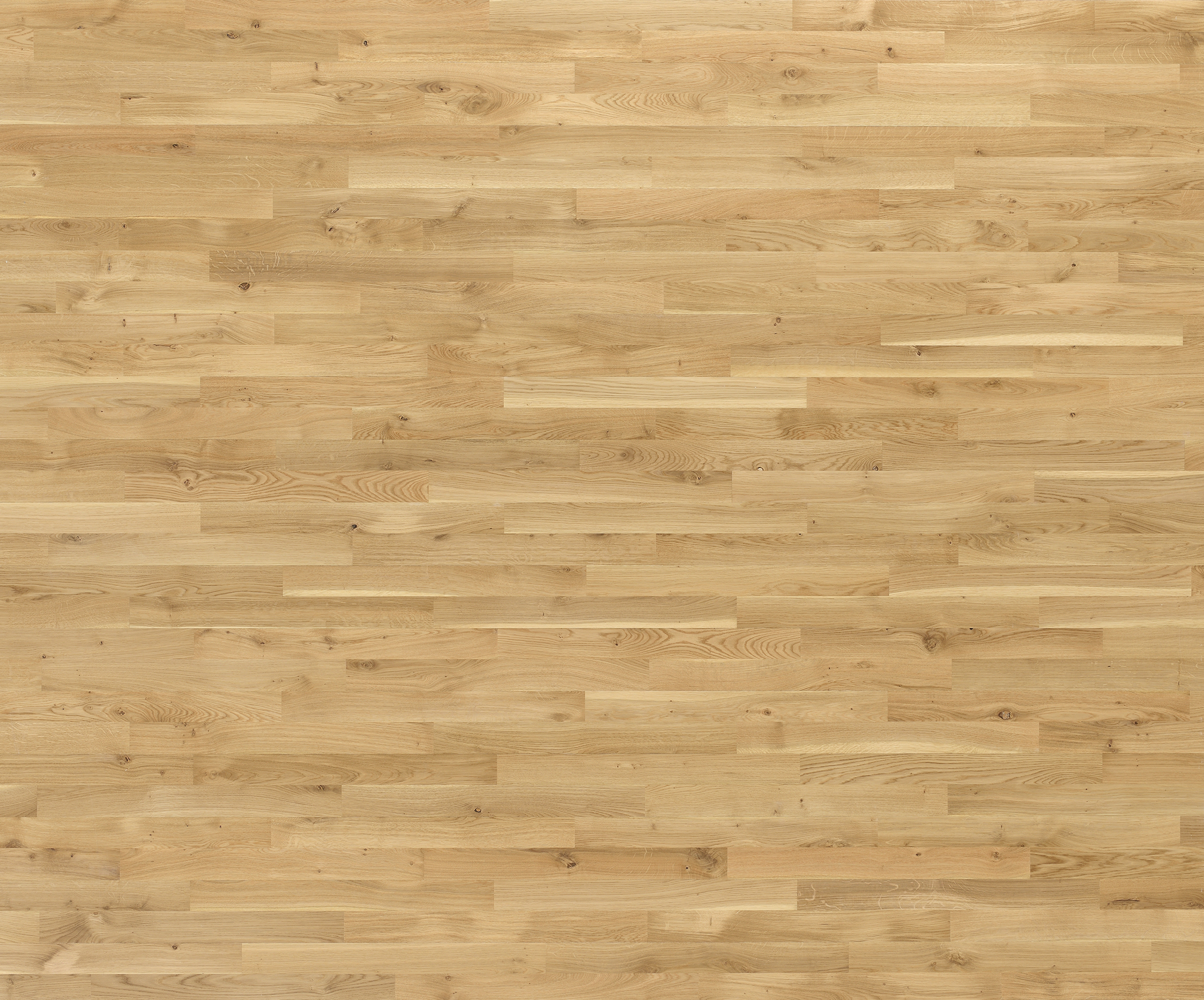
Here is what the Junckers 2-strip boards Prospec supplies actually are (as listed on Prospec's oak, beech and black oak product pages):
-
Thickness: 22mm solid hardwood
-
Width: 129mm
-
Length: 1830mm
-
Construction: two rows of solid staves assembled into one board
-
Finish (oak): ultra matte lacquer, prefinished at the factory
Each board shows two lines of staves, so the finished floor reads as parquet.
The 22mm thickness is the number to hold on to. It means there is real hardwood to sand into years from now, and Prospec's timber flooring page notes that Junckers floors can be sanded back several times over their lifespan. Prefinishing means there is no on-site sanding and sealing before you can walk on it.
Installation follows Junckers' own instructions, and they surprise people. Solid boards are laid on arrival at the building and stay in their wrapping until just before laying, with no acclimatising on site (Junckers installation instructions C 1.1). The same instructions set limits for indoor humidity and for residual moisture in the screed at the time of laying. Ask your installer to measure and record both.
Singapore's mean annual relative humidity is around 82% (Meteorological Service Singapore, 1991 to 2020 climate records), which is why those readings matter here. Junckers solid wood flooring is widely used in Singapore and other tropical regions, and it performs well when installed according to Junckers guidelines.
Reading a Grade Sample
Species sets the base colour. Grading sets the character.
Prospec's Junckers range covers three looks:
-
Oak has a warm, golden glow and an interesting grain, and natural ageing gives it an authentic appearance over time.
-
Beech is paler, with a uniform structure and white to reddish heartwood. Its strength makes it a hard-wearing floor, and it is specified for sports and multi-purpose halls as well as homes.
-
Black oak recreates the look of bog oak, timber left submerged for centuries until it turns almost black, through a colouring technique applied to solid oak.
Within a species, the grade decides how much variation you see between staves. The Harmony grade has more colour and grain variation between individual staves, with lighter tones along the grain and in the sapwood. Medium-sized knots and fine natural splits occur to some degree, and knots and other irregularities are factory filled with a one-colour filler (Junckers grading description).
On a parquet floor that variation multiplies. Every board shows two rows of staves, so a room holds a great many small pieces side by side, and the grade's character shows across the whole surface rather than in a few long planks. A sample photographed under showroom lights rarely matches how it reads across sixty square metres. Ask for several full boards and lay them on the floor of the actual room.
What to Ask a Contractor Quoting Parquet
"Oak parquet, supply and lay" tells you almost nothing. Ask for these in writing:
-
Solid or engineered? If engineered, how thick is the hardwood layer above the core?
-
Board or block dimensions. Thickness, width and length, so you can compare like with like.
-
Pattern and laying method. Strip, block or herringbone, and how the floor is fixed to the subfloor.
-
Species, grade and finish. Named grade, not "natural", and whether the finish is factory-applied or done on site.
-
Moisture readings. Who measures the screed and the indoor humidity before laying, and against which limits.
-
Certification. Junckers floors are Green Label Singapore certified and carry the Danish Indoor Climate label, useful paperwork on projects with green building targets.
To compare species and grades for your project, see the timber flooring collection or ask the Prospec team for samples.
Frequently Asked Questions
What is the difference between parquet and timber flooring?
Parquet is a type of timber flooring built from small staves or blocks, laid in a pattern such as herringbone, block or strip. "Timber flooring" is the wider term and also covers wide single planks. Either can be solid or engineered.
What is 2-strip parquet?
A board made of two rows of solid hardwood staves joined into one, then laid in a staggered pattern. It gives the fine-lined look of parquet with the faster installation of a board. The Junckers 2-strip boards Prospec supplies are 22mm thick, 129mm wide and 1830mm long.
Is solid oak parquet the same as engineered oak parquet?
No. Solid oak parquet is oak through its full thickness and can be sanded back several times over its life. Engineered oak parquet has an oak top layer on a plywood or softwood core, so it can only be sanded as far as that layer allows.
Should parquet boards be left to acclimatise before laying?
Not for Junckers solid boards. Junckers instructs that they are laid on arrival and kept in their wrapping until just before laying, with no acclimatising on site. What does need checking beforehand is the screed moisture and the indoor humidity.
Why does a parquet sample look different from the finished floor?
A sample shows a few staves. A finished parquet floor shows a whole room of them side by side, so the grade's colour and grain variation reads across the entire floor. Lay several full boards in the actual space before you decide.