
27 July 2026
Phenolic Toilet Cubicles, Urinal Partitions and Lockers

Table of Contents
Washrooms and changing rooms are the hardest-working rooms in any building, and the first place a cheap fit-out shows its age. For wet, high-traffic areas in Singapore, solid phenolic panels are the material to specify for toilet cubicles, urinal partitions and lockers, because they are water-resistant and anti-microbial through their full thickness rather than only at the surface. Standard HPL board has its place, but that place is not a shower room.
This guide explains the material difference in plain terms, then walks through the cubicle mounting systems and locker formats that make up Prospec's Marathon range of toilet cubicles and urinal partitions, which is Green Label certified for Singapore projects.
Key Takeaways
-
Phenolic and HPL are related laminates, but solid phenolic is dense compact laminate through its entire core, while standard HPL is a thin decorative skin over a particleboard or MDF substrate.
-
Compact laminates are manufactured to the EN 438 standard, with a dense resin-and-kraft core that gives panels their rigidity and moisture resistance.
-
The mounting system matters as much as the panel: full-glass, ceiling-hung and floor-mounted cubicle systems suit different buildings and cleaning regimes.
Why Material Choice Decides Washroom Lifespan
Two washrooms can look identical on handover day. Five years later, one has swollen door edges, delaminated corners and rusted fittings, and the other looks close to new. The difference is rarely the design. It is the panel material and how it copes with water.
Washroom panels live with splashing, condensation, daily chemical cleaning and constant impact from doors and users. School and gym changing rooms add wet swimwear, kit bags and teenagers. A material that merely tolerates moisture at its surface will eventually let it in at the cut edges, and once the core swells there is no repair, only replacement.
That is the case for specifying the panel core, not just the laminate colour, and it is why the phenolic vs HPL question comes up on nearly every project we quote.
Phenolic and HPL, Explained
The terms get used loosely in the market, which causes real specification mistakes. Here is the honest distinction.
HPL (high pressure laminate) is a decorative surface sheet, usually under 1mm thick, made from kraft paper and resin pressed under heat. In typical washroom products it is bonded onto a substrate of particleboard or MDF. The surface is tough. The core is not. If water reaches the substrate through an edge or a screw hole, the panel swells.
Solid phenolic, also called compact laminate, uses the same chemistry but is pressed as a thick, self-supporting panel. Layer upon layer of resin-impregnated kraft is compressed into a dense black core with the decorative surface fused on both faces. There is no separate substrate to protect. Compact laminates of this type are manufactured to the EN 438 standard, and the dense core is what gives the panels their rigidity, impact resistance and indifference to water.
Marathon cubicles, urinal partitions and lockers use solid phenolic panels with anti-microbial and water-resistant properties through the panel, not just on it. Cut edges can be left exposed and simply polished, which is why phenolic washrooms keep their lines after years of cleaning.
Where does standard HPL board belong? Dry areas. Office feature panelling, cabinet fronts, places where the budget matters and water does not. Specify it in a shower room and you are buying the room twice.
Choosing a Cubicle System
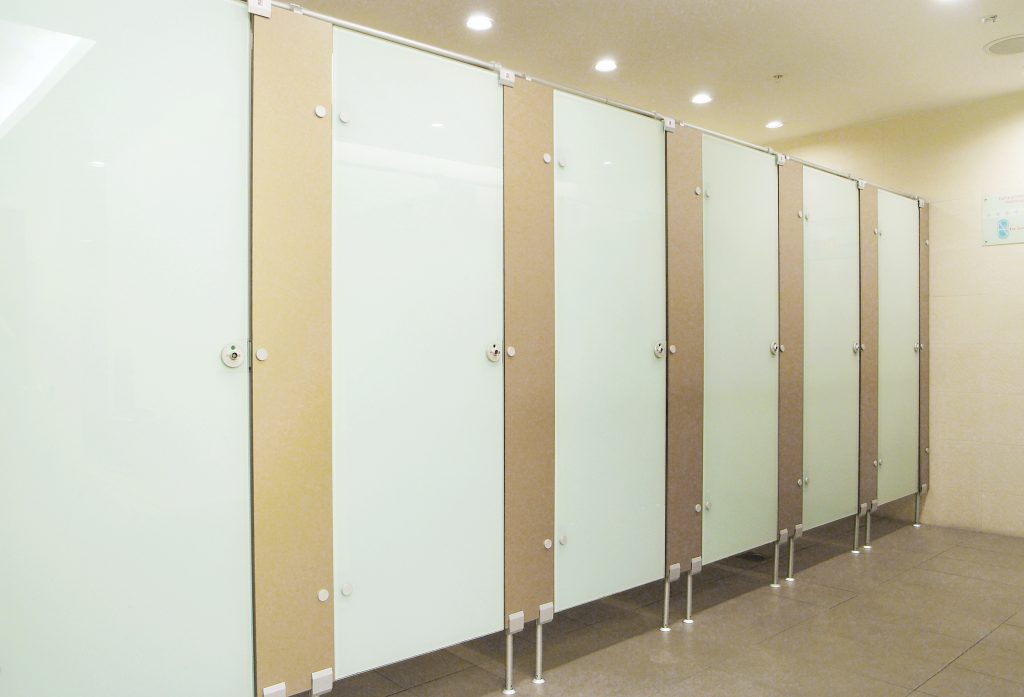
Panel material settled, the next decision is how the cubicles meet the floor and ceiling. The Marathon range covers three approaches.
Full glass, for front-of-house
The M600 pairs slim tempered-glass dividers with phenolic doors. Glass dividers take up less depth than brick or laminate partitions and let daylight through, which is why this system is specified in hotels, shopping malls, corporate offices and premium F&B washrooms where the washroom is part of the guest experience.
Ceiling-hung, for clean floors
The MC120 and MC190 systems suspend phenolic toilet partitions from above, with no floor-mounted pedestals at all. Cleaners can machine-wash the floor without working around feet, and the room reads as larger. Hotels, offices, malls and schools specify this where cleanliness and a modern look are the priorities.
Floor-mounted, for maximum service life
The MF120 and MF190 anchor solid phenolic partitions at both floor and headrail for maximum rigidity. This is the longest-serving system in the range and the default for high-traffic commercial washrooms, institutional buildings and schools, where doors get slammed thousands of times a year.
Urinal partitions complete the washroom in the same phenolic panels, so the whole room wears at the same rate and matches visually.
Lockers for Schools, Gyms and Clubs
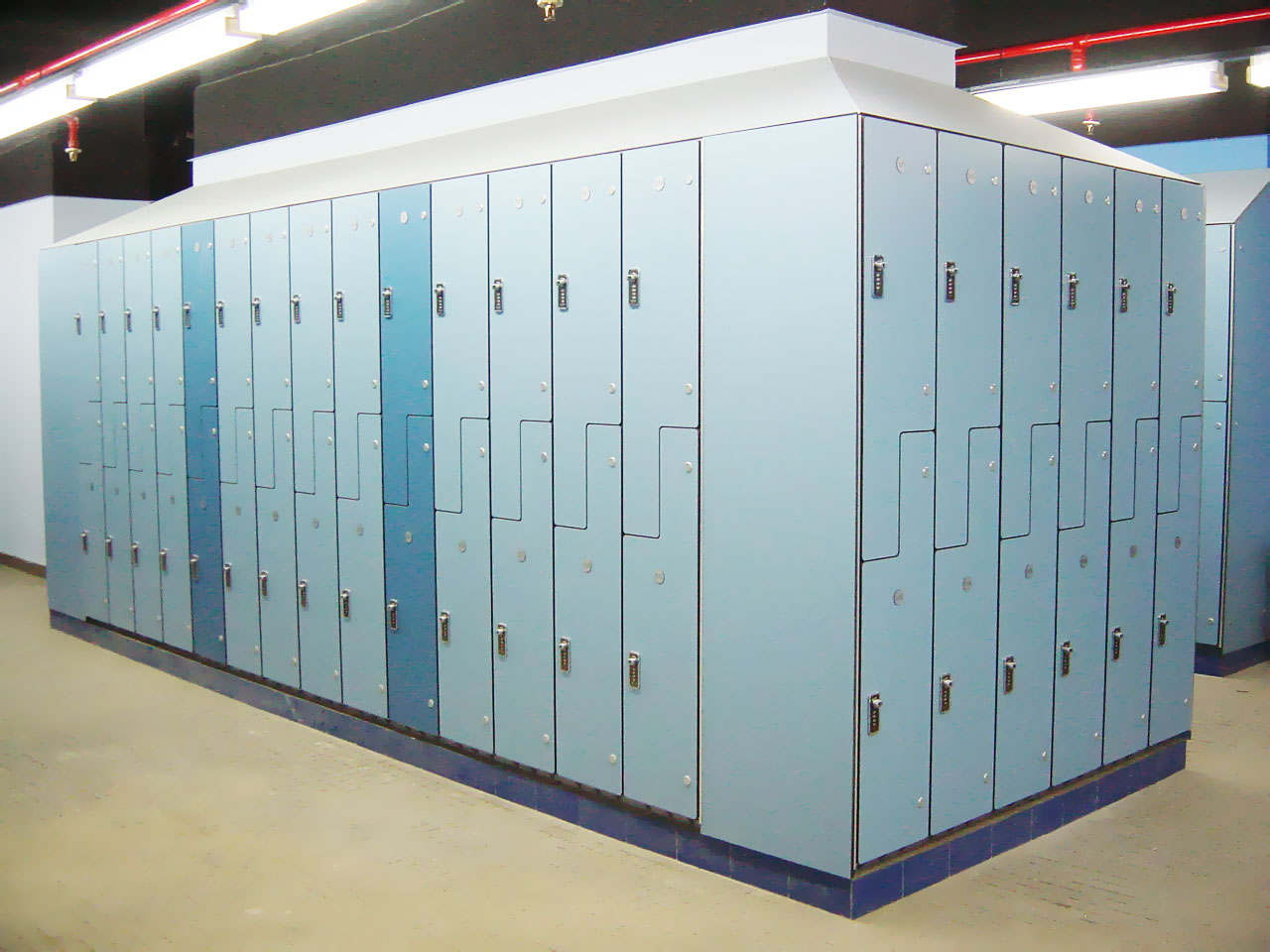
Lockers face the same conditions as cubicles plus one more: they get hit, sat on and loaded with wet kit daily. The same solid phenolic construction carries over, in four formats.
Classic lockers are the compact-footprint workhorse, available in single, double, four-tier and six-tier configurations. Schools specify them for cloakrooms because more units fit into a given run, and Singapore has more than 300 schools (Ministry of Education) fitting out and refreshing exactly these spaces.
Jumbo lockers are the extra-wide format for premium gyms, hotel staff changing rooms and swim schools, sized for uniforms and full kit bags rather than books.
Z lockers interlock in a Z-shape so each user gets full-height hanging space in roughly half the floor area of two stacked lockers. For a tight gym changing room, this is often the difference between fitting the member count and not.
Glass lockers bring the full-glass aesthetic to front-of-house changing areas in clubs and spas.
The format decision is really a floor-area and user-profile decision. Count the users, measure the run, then choose the format that fits both.
A Buyer's Checklist
Before signing off a washroom or changing-room package, check these six points:
-
Core material, in writing. "Laminate finish" tells you nothing. Ask whether the panel is solid phenolic compact laminate or HPL-faced board, and get it on the quote.
-
Wet or dry area. Showers, pools and changing rooms need solid phenolic. Dry office washrooms give you more latitude.
-
Mounting system vs cleaning regime. If floors are machine-cleaned, ceiling-hung earns its premium. If durability tops everything, floor-mounted.
-
Hardware quality. Stainless fittings and through-panel fixings should match the panel's lifespan. Rusted hinges on a sound panel still read as a failed washroom.
-
Certifications. For Singapore projects chasing Green Mark points, note that the Marathon range is Green Label certified.
-
A real sample. Panels, colours and edge finishes should be approved physically, not from a PDF.
To scope a cubicle or locker package for a specific project, contact the Prospec team with your drawings and user counts.
Frequently Asked Questions
What is the difference between phenolic and HPL toilet partitions?
Solid phenolic is compact laminate through its full thickness, with a dense resin core that is water-resistant and anti-microbial throughout. Standard HPL partitions are a thin laminate skin bonded to particleboard or MDF, so moisture entering at an edge can swell the core. For wet areas, specify solid phenolic.
Are phenolic toilet partitions suitable for schools?
Yes, they are the standard choice. School washrooms combine high traffic, frequent cleaning and rough use, and solid phenolic panels resist impact, moisture and bacteria through the panel. Floor-mounted systems such as the MF120/MF190 suit schools particularly well for their rigidity.
What is a ceiling-hung toilet cubicle?
A system where the partitions hang from overhead structure with no floor pedestals, such as the Marathon MC120/MC190. The clear floor makes machine cleaning faster and gives the washroom a more open look.
Which locker type fits the most users into a small changing room?
Z lockers. Their interlocking Z-shape gives every user full-height hanging space in roughly half the floor area that two stacked conventional lockers would need.
Do urinal partitions come in the same material as toilet cubicles?
Yes. Marathon urinal partitions use the same solid phenolic panels as the cubicle systems, so the whole washroom matches visually and wears at the same rate.
