11 November 2026
What an Indoor Basketball Court Floor Has to Get Right
Table of Contents
- Measure the Hall First
- Why a Basketball Floor Needs Give
- Choosing a Floor for the Level of Play
- Finish and Light
- Frequently Asked Questions
Two things are usually fixed before anyone chooses the timber for a basketball court: the size of the hall, and the slab the floor will sit on.
Good basketball court flooring is a sprung solid hardwood floor with enough give to protect players, an even ball bounce across the whole court, and a system chosen for the slab and the level of play.
This article takes the decisions in the order a project meets them, using the figures in FIBA's Venue Guide. Our wooden sports flooring page covers the full range we supply for badminton, basketball and multi-sport halls.
Key Takeaways
- A full competition court needs at least 32m by 19m of clear floor. FIBA's guide sets a 28m by 15m playing area inside a boundary area of at least 2m.
- The floor needs controlled give. FIBA recommends point-elastic floors only for children's age groups, and Junckers classes the Clip System and UnoBat 45 as area-elastic.
- The building narrows the choice. The Clip System suits a flat slab with little height to spare, and UnoBat 45 suits competition play and halls with seating.
Measure the Hall First
The floor area comes first, because no system can fix a hall that is too small.
FIBA's guide sets the inner playing area at 28.0m long and 15.0m wide, surrounded by a boundary area of at least 2.0m. That makes the minimum court area 32.0m by 19.0m. Above it, the space has to be free of obstruction for at least 7.0m, and FIBA recommends a clearance of at least 14.0m in arenas that will host top-level competitions with large broadcast set-ups.
None of that includes the people around the court. The guide places the scorer's table beyond the edge of the 2.0m boundary, and asks for the bench seats to sit far enough back that people can pass without encroaching on the boundary area.
Not every hall needs all of it. One that will only ever see training can be planned around a smaller court, and that may be the right call. Decide it knowingly. If the hall may one day host competition, the full court and its boundary have to fit, with room left for the table and benches.
The boundary is easy to give away. A stage or a storeroom nibbling at the end line costs very little on a plan. A player who lands out of bounds at speed finds it.
Why a Basketball Floor Needs Give
A basketball floor has to do two things at once. FIBA's guide lists both among the key characteristics of a court floor: a firm and level surface for the players' grip and the bounce of the ball, and shock absorbency, which it calls "an essential characteristic in terms of player safety" and credits with mitigating wear and tear on joints and tendons.
Area-elastic and point-elastic floors
Sports floors are described by how they flex. In FIBA's definitions, an area-elastic floor deflects a force over a relatively large area around the point where it lands. A point-elastic floor deflects only at or close to that point.
The guide says point-elastic flooring is only recommended for children's age groups, where weight loads are reduced. For a hall where teenagers and adults play, that points away from a point-elastic floor. Junckers classes both of the systems covered below as area-elastic.
What the slab does to the bounce
The bounce depends on what is under the floor as well. FIBA's guide says any flooring system needs to sit on a stable, perfectly level concrete floor, otherwise "dead spots" can occur. That is a good reason to have the slab surveyed before a floor system is chosen.
Choosing a Floor for the Level of Play
Start with the highest level of basketball the hall will ever host, because that sets the floor.
FIBA's guide works with two competition levels. Level 1 covers FIBA's national team and club competitions, plus other elite-level competitions, and must be played on a FIBA Approved wooden or glass surface. Level 2 is every other competition. It may also be played on synthetic flooring, and for it the guide says FIBA Approved equipment is "strongly recommended".
If the hall will host sanctioned games, settle the level first. Then confirm the certified system and the federation approval the venue needs with our team, and get it in writing. Junckers' standing with FIBA is covered in our news piece on the FIBA partnership.
UnoBat 45 is certified to EN 14904 class A4 and carries FIBA, the Badminton World Federation (BWF) and the International Handball Federation (IHF) among its sports standards. It suits a wide variety of sports from beginner to international competition level, and it can support heavy loads such as permanent or retractable seating without long-term deformation or damage.
The Clip System, which we lay on 10mm SportsFoam, is certified to class A3 and suits small sports halls, dance and fitness rooms. For a court that will host sanctioned basketball, start from UnoBat 45 and confirm the rating with our team before the drawings are fixed.
The class is a measure of give. In the EN 14904 requirements Junckers publishes with its test results, class A3 means shock absorption of 40% to under 55% and class A4 means 55% to under 75%. Both classes ask for a ball bounce of at least 90%.
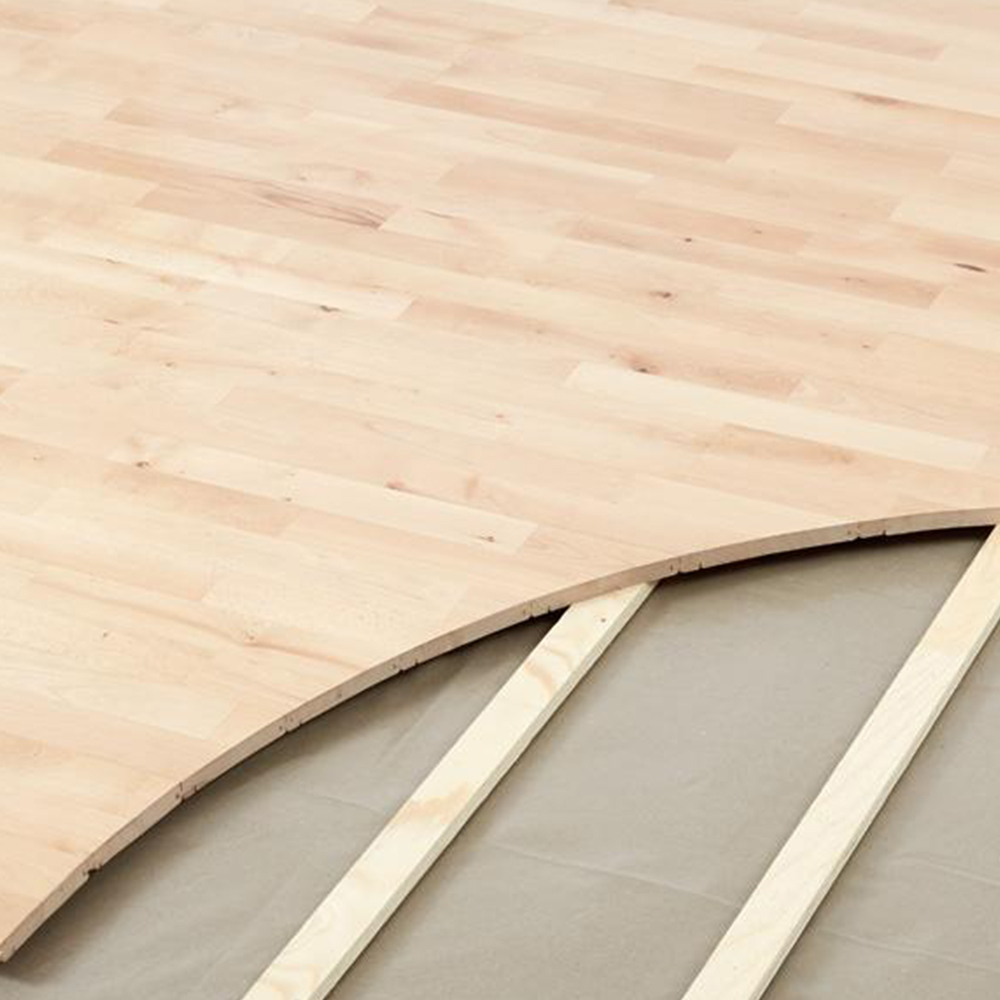
Then let the building narrow it down. If the finished floor has to sit within a few centimetres of the door thresholds and the slab is flat, the 32mm Clip System is built for that: it is designed for flat subfloors where the finished floor height has to stay low. UnoBat 45 is 45mm high. If retractable seating will run along a side line, start from UnoBat 45.
Finish and Light
Glare and sunlight
FIBA's guide says glare on the court floor and to the players should be avoided, and one of its answers is to position the light fittings at a sufficient height above the court. It also warns that direct sunlight may damage the court flooring over time, and says a shading system should be installed where large windows let the sun shine directly on the floor. The lighting layout and the glazing belong in the same conversation as the floor.
The coating
The same guide says the upper surface of a wooden floor should be protected with a coating. The Clip System and UnoBat 45 boards arrive prefinished. Junckers solid sports flooring can be re-sanded and refinished, and Junckers' data for both systems allows sanding to bare wood and re-sealing 8 to 10 times.
We provide ongoing maintenance to keep playing surfaces in competition condition. Our guide to maintaining hardwood sports floors covers the routine.
Planning a court? Over the past decades we have installed more than 80,000 square metres of timber sports flooring in Singapore. Get in touch with us while the drawings are still open, so the hall size and the slab can still shape the floor choice.
Frequently Asked Questions
How much space does an indoor basketball court need?
FIBA's guide sets the playing area at 28m by 15m with a boundary area of at least 2m all round, so 32m by 19m at minimum, with at least 7m free of obstruction above it. The scorer's table and the team benches sit outside that.
Is timber better than a synthetic floor for basketball?
For the top tier, FIBA's guide settles it: Level 1 competitions must be played on a FIBA Approved wooden or glass surface, and synthetic flooring may be used at Level 2. Separately, it recommends point-elastic floors, which deflect only at or close to the point of impact, for children's age groups only. The guide also notes that basketball court flooring is traditionally made from solid hardwoods such as maple, beech, oak and ash.
Which Junckers system carries a FIBA standard?
UnoBat 45 carries FIBA among its sports standards, alongside BWF and IHF. For sanctioned competition, confirm the certified system and the approval your venue needs with our team.
Can a basketball court share the floor with badminton?
Yes. UnoBat 45 is suited to multi-functional sports halls and carries BWF as well as FIBA among its sports standards.
Which floor suits a hall with little height to spare?
The Clip System. It is 32mm high, designed for flat subfloors, and ideal for refurbishment projects or wherever a minimal finished floor height is required. If the hall may host competition or needs retractable seating, start from UnoBat 45, which is certified to EN 14904 class A4.